
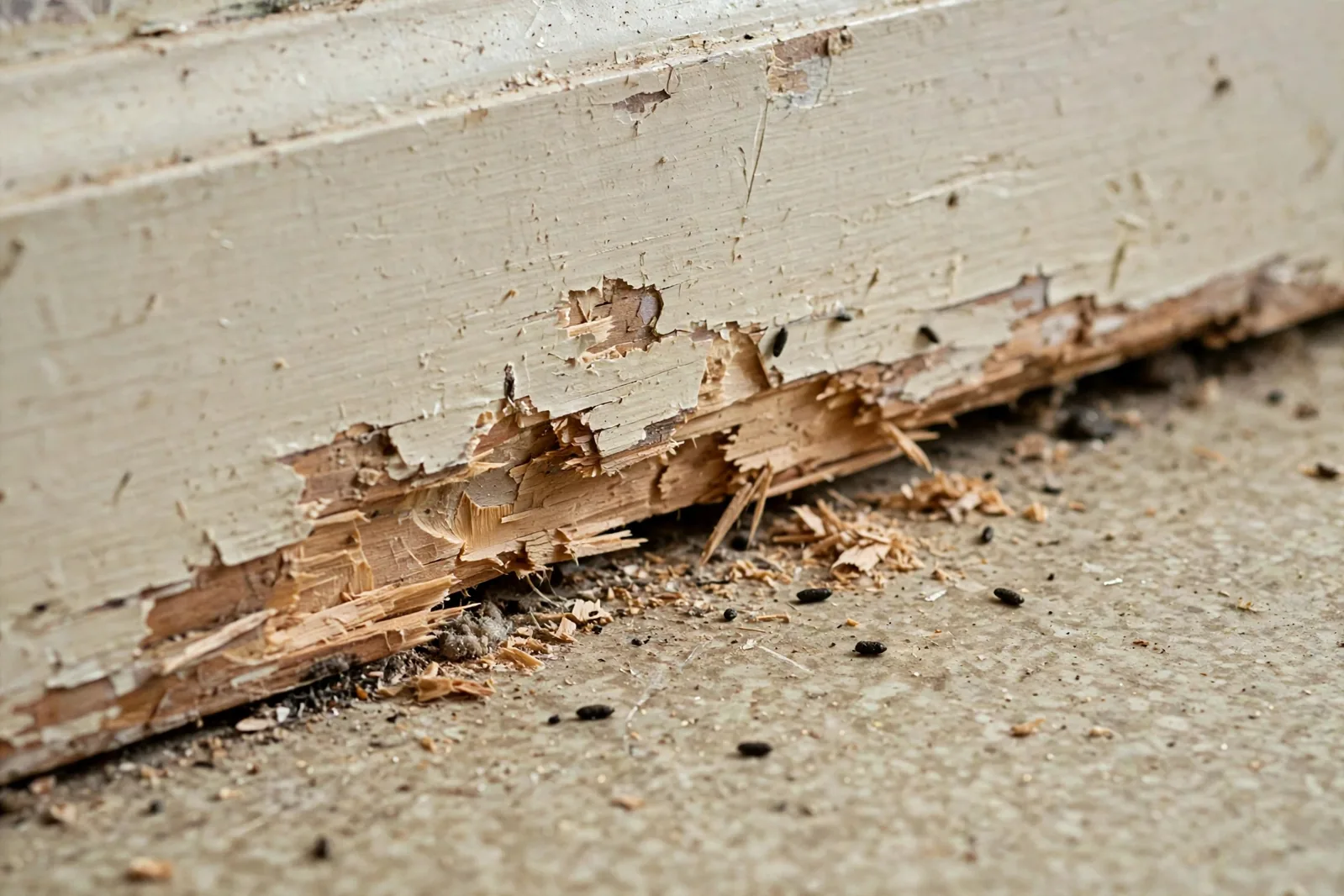
Droppings are the first clue
Mouse droppings are the most reliable early sign of mice in a home. They are small, dark, and rice-shaped, and they show up where mice travel and feed: kitchen drawers, pantry shelves, under sinks, along baseboards, and in attics. Fresh droppings are dark and soft; older ones turn gray and crumbly. Finding a few in one spot usually means mice pass through there, while larger numbers in several rooms suggest mice are living in the house, not just visiting.
Droppings should be handled carefully. Do not sweep them up dry, which can stir dust into the air. A few droppings in a kitchen can be cleaned carefully with gloves and damp cleaning, but larger amounts — especially in an attic — are better handled as part of a rodent droppings cleanup, where protective methods are used and the full extent is found.
Sounds in walls and ceilings
Mice in attic and wall spaces make light scratching, scurrying, and gnawing sounds, most often at night when the house is quiet and mice are active. The sounds tend to come from above bedrooms or behind kitchen walls, and they may stop and start as mice move between nesting and feeding areas.
Sounds help separate mice from rats. Mice sound light and quick; rats in a crawl space or attic sound heavier and slower. If the sounds are loud, or if you hear them in a crawl space rather than a wall void, rats are the more likely culprit — and a mice inspection can confirm which rodent you have, because the plan differs.
Gnaw marks and damaged packaging
Mice gnaw constantly to keep their teeth worn down, and the marks show up on wood, plastic, and food packaging. Look for small, rough-edged gnaw marks on baseboards, door frames, pantry boxes, and plastic containers, plus shredded paper or fabric used as nesting material in quiet corners, drawers, and attic insulation.
Food packaging is a common first discovery: a cereal box with a chewed corner, a bag of pet food with a hole, or droppings inside a pantry. Mice eat small amounts from many sources rather than finishing one item, so several nibbled packages point to mice more clearly than one damaged box.
Nesting material and smell
Mice build nests from shredded paper, fabric, insulation, and plant material, tucked into quiet, warm spots: attic corners, wall voids, behind appliances, and inside stored boxes. Finding a nest, or finding shredded material in a drawer or attic corner, means mice are living in the house, not just passing through.
A stale, musky smell in a closed room, cupboard, or attic can also signal mice, especially where droppings have built up. A strong, sharp smell in one spot may mean a dead mouse in a wall void, which needs its own step — dead rodent removal — because the smell lasts until the source is gone.
What to do when you find signs
Start with an inspection. Signs tell you mice are present, but they do not tell you how many there are, where they nest, or where they enter — and those three answers decide the plan. An inspection maps activity and entry points, then removal, sealing, and cleanup follow in that order for most homes.
In the meantime, store food in sealed containers, clear pantry spills promptly, and avoid leaving pet food out overnight. These steps do not solve an established problem, but they make the house less inviting while the plan is set. If you find droppings in several rooms, or hear nightly activity in the walls, call sooner rather than later — established attic and wall-void populations grow, and the cleanup grows with them.
Mice in Olympia: why this city
Olympia gives mice what they need: mild, wet weather, plenty of green cover, and a large stock of older homes. As fall arrives and nights cool, mice that spent summer in yards, greenbelts, and outbuildings move toward warmth and food, and houses are the obvious destination. Homes near greenbelts, the waterfront, and wooded lots feel this first, but any Olympia home with a gap can join the list.
The city's older neighborhoods add to the pattern. Homes in South Capitol, the Eastside, and Bigelow Highlands have settled foundations and older rooflines that open gaps over time, while even newer subdivisions develop pipe and vent gaps as sealants age in the damp climate. That combination — seasonal pressure plus older housing — is why mouse signs in Olympia are worth acting on rather than watching.
When to call a provider
Call when the signs point to an established problem rather than a single visitor: droppings in several rooms, nightly sounds in walls or ceilings, nesting material in the attic, or a stale, musky smell in a closed room. A single dropping in a garage after a door was left open is different from droppings in the kitchen, pantry, and attic together — the second pattern means mice are living in the house.
When you call, describe what you found and where: which rooms, what the droppings look like, whether you hear sounds and when, and whether you have seen a mouse itself. Those details help the provider plan the inspection and come prepared with the right traps and sealing materials for your home.
Droppings in different rooms: what the pattern means
Where droppings appear says as much as the droppings themselves. Droppings confined to a garage or a single pantry shelf often mean mice passing through or a very recent arrival, while droppings in the kitchen, the pantry, and the attic together mean mice are living in the house and using several zones. Droppings along a single baseboard line suggest a runway — a route mice travel repeatedly — while droppings scattered across a room suggest feeding in place rather than travel.
Freshness adds another layer. Fresh droppings are dark and soft, while older ones turn gray and crumbly, so a mix of fresh and old droppings in the same spot means ongoing activity rather than a one-time visit. If you find only old, gray droppings and no other signs, the mice may have moved on — but the gaps they used are still open, and a mice inspection can confirm whether activity is current before any plan is set.
Signs that point to rats instead
Some signs that look like a mouse problem point to rats, and the distinction changes the plan. Larger, capsule-shaped droppings — roughly three quarters of an inch long — point to rats, as do heavier, slower sounds in a crawl space rather than light scratching in a wall void. Dark, greasy rub marks along baseboards and beams, where rats travel the same routes repeatedly, are another rat clue, as are burrow holes near foundations and larger gnaw marks on wood and packaging.
If several of these appear together, rats are the more likely culprit, and our guide to mice or rats in Olympia walks through the full comparison. Either way, the next step is the same: describe what you found and where when you call, so the provider comes prepared for the species in your home, with the right trap sizes and the right areas to check first.
Related services and areas
Related services: Mice Inspection, Rodent Droppings Cleanup. Also see mice control in Eastside and mice control in Olympia, WA.